
01
Consciousness
Shiva represents consciousness: The eternal, unchanging foundation of existence.
DeogharAwareness · Dharma · Transformation
The spiritual anchor
Samba Sadashiv is not kept at a distance as a story. The name points to the uncreated ground of awareness, svayambhu. When attention returns there, fear has less room to run the day.

ॐ
Who he is
Samb Sadashiv, also written as Sāmba Sadāśiva (साम्ब सदाशिव), is a revered expression of Lord Shiva in Sanatan Dharma. The name represents the eternal, benevolent and supreme aspect of Shiva, together with the Divine Mother, Ambā or Goddess Parvati.
The word Sāmba is traditionally understood as Sa + Amba, meaning “with the Mother”. Sadāśiva means the eternally auspicious one — the timeless divine reality beyond birth, decay and destruction.
Samb Sadashiv therefore represents the divine unity of Shiva and Shakti: the eternal consciousness and the primordial creative power. Their union symbolizes the foundation of existence, balance, harmony and the continuous flow of cosmic energy.
साम्बSa + AmbaWith the Mother
सदाशिवSadāśivaEternally auspicious
शक्तिShaktiCreative power
Meaning
In Shaiva traditions, Sadashiv is revered as the supreme, eternal reality — beyond the limitations of time, space and material existence.
Lord Shiva is not only associated with transformation and dissolution, but also with wisdom, compassion, meditation, liberation and the ultimate truth.
Through devotion to Sadashiv, a seeker is encouraged to move beyond ego, attachment, ignorance and fear, and progress towards inner peace and self-realisation.
The divine union
Sanatan Dharma recognises Shiva and Shakti as inseparable principles of the universe.
01
Shiva represents consciousness: The eternal, unchanging foundation of existence.
02
Shakti represents divine energy: The power through which creation, movement and transformation take place.
03
Their union represents completeness: Consciousness and energy are complementary and inseparable.
Samb Sadashiv honours this divine unity. It teaches that spiritual completeness comes through harmony, balance, awareness and reverence for both divine principles.
Panchakritya
The Shiva Purana describes five cosmic functions associated with Lord Shiva. These are known as the Panchakritya:
01
Creation
The manifestation of the universe and all forms of life.
02
Preservation
The maintenance and continuity of existence.
03
Dissolution
The transformation and withdrawal of creation.
04
Concealment
The veiling of ultimate truth through the limitations of worldly experience.
05
Divine Grace
The blessing that leads the soul towards knowledge, freedom and liberation.
These five acts express the continuous rhythm of existence — creation, preservation, transformation, concealment and spiritual awakening.
What the form carries
The symbols associated with Lord Shiva carry profound spiritual meanings:
त्रिशूल
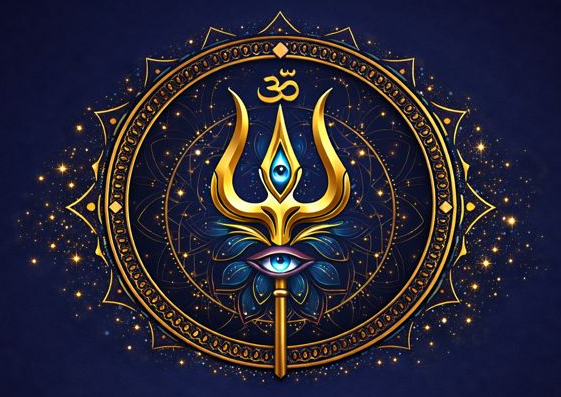
The Trishula represents divine power and is commonly interpreted as symbolising the three gunas — Sattva, Rajas and Tamas. It reminds us to rise above their limitations and seek spiritual balance.
डमरू
The Damru represents the primordial rhythm and vibration of creation. Its sound symbolises the cosmic movement through which existence unfolds.
चन्द्र
The moon represents the passage of time and the changing nature of the mind. Shiva wearing the crescent moon symbolises mastery over time and mental fluctuations.
गंगा
The sacred river flowing from Shiva's matted hair represents purity, wisdom and spiritual liberation.
ज्ञान
The third eye represents inner vision, discernment and the destruction of ignorance. It reminds seekers to look beyond appearances and recognise deeper truth.
नाग
The serpent around Shiva's neck is associated with mastery over fear, ego, death and the forces of nature.
विभूति
Vibhuti reminds us that material forms are temporary. It encourages humility, detachment and awareness of the eternal.
How a life is shaped
The worship and contemplation of Samb Sadashiv inspire several important values:
Develop calmness and stability even during difficult circumstances.
Treat every living being with kindness and respect.
Follow the path of honesty, wisdom and righteousness.
Perform your duties without excessive attachment to results.
Practise control over thoughts, words and actions.
Let go of pride and recognise the divine presence in all existence.
Cultivate meditation, reflection and understanding of the Self.
The true spirit of Shiva devotion is not limited to rituals. It is also reflected in how we live, how we treat others and how we respond to life's challenges.
The name, spoken
One traditional devotional mantra is:
ॐ साम्बसदाशिवाय नमः
Om Sāmba Sadāśivāya Namaḥ
Meaning: Salutations to the eternally auspicious Lord Shiva, together with the Divine Mother.
Devotees may chant this mantra with sincerity, concentration and devotion. Repetition of a sacred mantra can help cultivate mental focus, inner calmness and a deeper devotional connection.
Another widely practised mantra is:
ॐ नमः शिवाय
Om Namah Shivaya
This sacred Panchakshara mantra is a salutation to Lord Shiva and is deeply associated with spiritual purification, devotion and self-realisation.
A simple practice
Devotees may worship Samb Sadashiv according to their family traditions, spiritual practices and personal faith.
Monday and Maha Shivaratri are especially associated with the worship of Lord Shiva. Devotees may also observe Pradosh according to their tradition.
A simple devotional practice may include:
Begin with a clean and peaceful place of worship.
Light a diya and offer sincere prayers.
Offer water, flowers, Bilva leaves or other traditional offerings, according to one's practice.
Chant “Om Samb Sadashivaya Namah” or “Om Namah Shivaya”.
Spend a few moments in silent meditation.
Pray for wisdom, compassion, strength and the welfare of all living beings.
Liberation
Bhakti
Gyan
Karma
Dhyana
One of the central aspirations of Sanatan Dharma is Moksha — freedom from the cycle of birth and death and the realisation of ultimate spiritual truth.
The path towards spiritual liberation is traditionally cultivated through devotion (Bhakti), knowledge (Gyan), disciplined action (Karma) and meditation (Dhyana).
Samb Sadashiv represents the eternal divine reality towards which the seeker turns through devotion, contemplation and self-realisation.
The journey begins by understanding that peace and fulfilment cannot be found through material possessions alone. They arise through inner transformation, wisdom, compassion and awareness of the Divine.